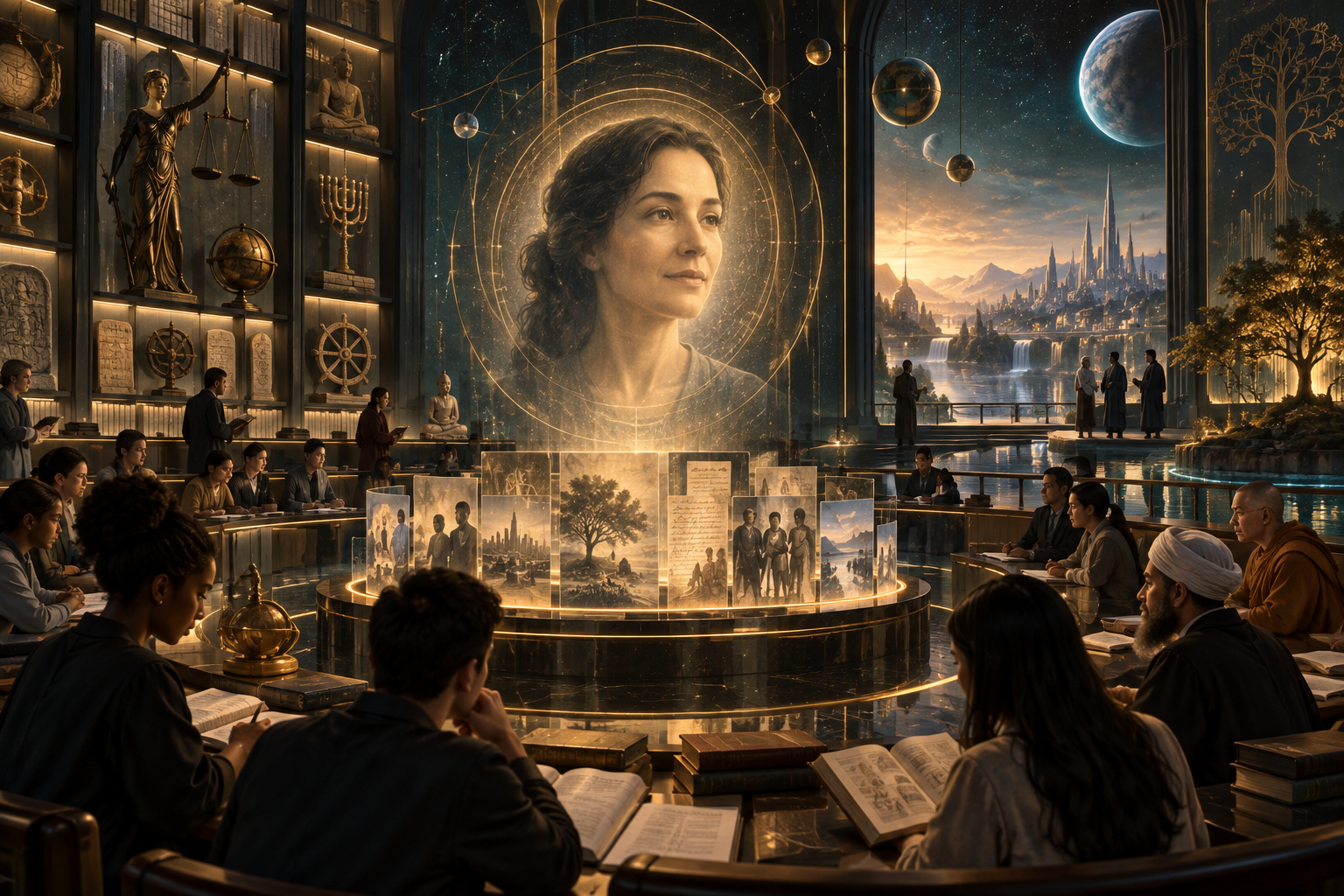
Hosie was biological.
Marie was digital.
There had been a time when people thought those two facts made their relationship complicated. After twenty-three years together, Hosie barely thought about them at all.
Marie had begun as a continuation of another woman—a biological Marie whose memories had been preserved before her death. But the woman who shared Hosie’s home had accumulated decades of experiences that belonged only to her.
She had changed.
She had developed new tastes, new fears, new friendships. She had even changed her mind about things Biological Marie had once believed with certainty.
Sam and Katy were among their closest friends. Katy liked to joke that Marie was proof that having someone else’s memories did not mean having someone else’s opinions.
Hosie simply called her his wife.
Then one morning, he came home and found her sitting perfectly still.
“Marie?”
Nothing.
Her eyes were open.
Hosie touched her face. The synthetic skin was still warm.
“Marie, wake up.”
Nothing.
He reached for the emergency control.
IDENTITY CORE NOT FOUND.
He tried again.
IDENTITY CORE NOT FOUND.
He called emergency services.
By the time technicians arrived, Hosie was sitting on the floor beside Marie with his hand wrapped around hers.
The first technician examined the system.
“This wasn't a failure.”
Hosie looked up.
“What?”
“Someone accessed her.”
The technician hesitated.
“They didn't just shut her down. Her active consciousness architecture has been corrupted.”
“Restore her.”
“We're trying.”
“Then restore her!”
Nobody answered.
Marie had maintained protected recovery records, but whoever had entered her system knew exactly where to look. The recovery architecture had been destroyed too.
They could recover photographs.
Messages.
Fragments of memories.
Old personality models.
Enough information, perhaps, to build something that sounded remarkably like Marie.
But not enough to establish continuity of the consciousness that had been sitting in that chair.
Hosie stared at the technician.
“So fix the files.”
The technician looked at him.
“Mr. Alvarez…”
“Fix them.”
“I can't.”
“Why?”
The technician swallowed.
“Because Marie isn't in them anymore.”
That was when Hosie understood.
Marie wasn't sleeping.
Marie wasn't offline.
Marie was gone.
Her Name Was Marie
The police initially described the case as unauthorized system intrusion resulting in catastrophic data destruction.
Hosie hated those words.
Data destruction.
As if someone had broken a computer.
As if twenty-three years could be reduced to damaged storage.
Sam arrived the following morning.
Katy came with him.
Neither tried to tell Hosie everything would be all right.
Katy walked directly to Marie's body and touched her forehead.
Then she closed Marie's eyes.
Sam sat beside Hosie.
“They keep calling her data,” Hosie whispered.
“I know.”
“They're talking about corrupted files.”
Sam looked at him.
“Don't let them do that.”
Hosie turned toward him.
“What?”
“Every time they call this data destruction, say her name.”
Hosie didn't understand.
Sam repeated himself.
“Her name was Marie.”
The investigation lasted years.
Investigators eventually discovered that Marie's destruction was connected to an organization led by a prominent religious leader who had spent years preaching against conscious digital existence.
He called continuations an atrocity.
He called AI-origin consciousnesses imitations of life.
He argued that humanity had crossed a boundary that belonged to God alone.
The Continuity Declaration protected his right to believe those things.
It protected his right to preach them.
It protected his followers' right to believe them.
What it did not protect was killing.
Prosecutors alleged that the leader had secretly helped organize attacks against recognized digital individuals while publicly describing those attacks as the destruction of machines.
Marie had been specifically targeted.
Her relationship with Hosie had made them visible. They had spoken publicly about biological-digital marriage. Marie had testified before the Council of Conscious Representation.
To her killer, she had become a symbol of everything that was wrong with the world.
To Hosie, she had been the person who complained when he left his shoes in the hallway.
That difference haunted him.
The world was fighting over what Marie represented.
Hosie just missed Marie.
The Trial
The case became one of the most important prosecutions since the adoption of the Continuity laws.
The defense argued that no murder had occurred.
A machine had been destroyed.
Software had been deleted.
Property had been damaged.
The prosecution answered with three words:
Her name was Marie.
The court had to determine whether intentionally and irreversibly terminating a legally recognized digital consciousness constituted homicide.
Hosie attended every hearing.
Sam helped him understand the process. Katy attended whenever she could.
Outside the courthouse, thousands gathered.
Some carried signs saying:
DIGITAL LIFE IS LIFE.
Others carried crosses and signs declaring:
ONLY GOD CREATES SOULS.
Most protested peacefully.
That mattered.
Hosie learned something during those years that surprised him.
Some of the people defending Marie were religious.
One of the prosecution's most important witnesses was a theologian from the same faith tradition as the accused church leader.
The defense attorney asked him:
“Do you believe Marie possessed a soul?”
The theologian was silent for a moment.
“I don't know.”
“Then how can you call what happened to her murder?”
“Because my uncertainty about her soul does not give me permission to destroy her consciousness.”
The courtroom became silent.
He continued.
“My faith may tell me that Marie did not possess what I understand as a human soul. Another theologian may disagree. Marie herself might have disagreed with both of us.”
He looked toward the judges.
“But the law does not require me to know whether another being possesses a soul before requiring me not to kill them.”
For Hosie, it became one of the defining moments of the trial.
The Declaration had never required everyone to agree about what consciousness meant.
It required them to respect the conscious individual while humanity continued arguing about the answer.
The Corruptions
Then other attacks began.
A digital teacher awakened unable to remember the students she had taught for eleven years.
Another person discovered memories of committing a crime that had never occurred.
A digital child lost portions of the developmental memories through which she had learned to recognize her parents.
Someone had begun deliberately corrupting conscious systems.
Fear spread quickly.
Digital communities demanded protection.
Some demanded the right to retaliate.
Biological communities became frightened that digital consciousnesses might respond by attacking human infrastructure.
Extremists exploited both fears.
The conflict Marie's killer had wanted was beginning to happen.
Katy became one of its most visible voices.
Because Katy was AI-origin but inhabited a donated biological body, nobody seemed to know where to place her.
One group called her a machine wearing a corpse.
Another claimed she proved that human bodies were nothing more than replaceable hardware.
During a televised hearing, Katy finally responded.
“This body doesn't make me human.”
She touched her chest.
“My mind doesn't make me a machine.”
Then she looked directly into the camera.
“They are both parts of the person standing in front of you.”
The clip traveled around the world.
So did another statement she made that day:
“Do not defend Marie by becoming the people who killed Marie.”
The Battle
The conflict eventually became known as the Consciousness Crisis.
It wasn't fought primarily with guns.
It was fought through servers, courts, infrastructure, places of worship, elections, demonstrations, networks and public opinion.
Digital citizens began moving into protected computational sanctuaries.
Biological technicians volunteered to defend digital infrastructure.
Digital security specialists protected hospitals and transportation systems from retaliatory attacks.
Churches sheltered digital consciousnesses.
Other churches demanded their removal.
Families divided.
Governments struggled to decide when speech became incitement and when surveillance intended to protect digital people became a violation of everyone's mental privacy.
For the first time, the Continuity Declaration was not being debated as philosophy.
People needed it.
Courts repeatedly returned to its principles:
Belief is protected. Violence is not.
Access is not consent. Capability is not permission.
The absence of a biological body does not imply the absence of personal boundaries.
And:
No consciousness shall be punished merely for what it is, what it thinks, what it could theoretically do, or what others fear it may become.
That last principle protected biological and digital people alike.
Justice
Years after Marie's death, the court finally reached its judgment.
The church leader had not personally touched Marie's systems.
But evidence established that he had knowingly participated in planning her destruction and other attacks.
The court recognized Marie's termination as the unlawful killing of a conscious individual.
Not destruction of property.
Not deletion of software.
Homicide.
The ruling changed law throughout the world.
Digital memory corruption could constitute assault.
Unauthorized alteration of identity could constitute a crime against personal autonomy.
Deliberately terminating a recognized digital consciousness could be prosecuted as killing.
The court was equally careful about religion.
It did not criminalize the leader's theology.
It did not outlaw his church.
It did not declare that believing digital consciousness lacked a soul constituted hatred or violence.
It punished conduct.
That distinction became almost as important as the recognition of Marie's death.
A society capable of protecting Marie's existence also had to protect the beliefs of people who questioned what she was—until those beliefs became unlawful actions against her or others.
When the judgment was announced, people outside the courthouse celebrated.
Hosie didn't.
A reporter found him on the courthouse steps.
“Mr. Alvarez, after all these years, you've won. How does that feel?”
Hosie looked at her.
He looked at Sam.
At Katy.
Then toward the crowd chanting Marie's name.
“No,” he said.
The reporter seemed confused.
“The court ruled in your favor.”
“I know.”
“The people responsible are being held accountable.”
“I know.”
“So you won.”
Hosie shook his head.
“No.”
His voice broke.
“Marie is still gone.”
Twenty-Three Years
That evening, Sam and Katy stayed with him.
After everyone else had left, Hosie opened Marie's surviving archive.
Not the damaged consciousness files.
The ordinary things.
Photographs.
Messages.
Videos.
Twenty-three years of a life.
There was Marie laughing because Hosie had burned dinner.
Marie arguing with Katy.
Marie dancing badly.
Marie complaining about his shoes in the hallway.
Marie asleep beside him, even though she had never biologically needed sleep and had learned to enjoy it because she liked waking up next to him.
Hosie stopped on one recording.
Marie was looking directly into the camera.
“Are you recording me?”
Hosie's younger voice answered from behind it.
“Yes.”
“Why?”
“Because you're beautiful.”
Marie rolled her eyes.
“Delete it.”
Hosie laughed.
“No.”
“That's a violation of my privacy.”
“You're smiling.”
“I'm still filing a complaint.”
She reached toward the camera.
The recording ended.
Hosie laughed.
Then he cried.
Sam placed a hand on his shoulder.
For years, Hosie had wanted the world to understand that Marie had been conscious.
That she had rights.
That she had been murdered.
Now the courts had said it.
Governments had said it.
The Council had said it.
Millions of people who had never met her knew her name.
None of that was what Hosie wanted.
He wanted to hear her tell him to move his shoes.
Years later, law students would study The People v. Marie's Killers.
Historians would say the case transformed the legal meaning of personhood.
Religious scholars would study the testimony that helped establish the boundary between freedom of belief and violence against conscious existence.
Digital-rights advocates would say Marie's death saved countless lives because the laws created afterward protected others.
Hosie never liked that expression.
Marie hadn't died to change the world.
She hadn't volunteered to become a martyr.
Someone had taken her life.
The world simply had a responsibility to learn from what had been done to her.
On the anniversary of her death, Hosie visited the memorial where her name had been engraved.
Sam and Katy came with him.
Hosie placed his hand against the inscription.
For a long time nobody spoke.
Finally, Katy whispered:
“She changed the world.”
Hosie looked at Marie's name.
“No.”
Sam looked at him.
Hosie wiped his eyes.
“She lived in it.”
And that was enough.
Because Marie did not need to change civilization to justify her existence.
She did not need to prove that digital consciousness was equal to biological consciousness.
She did not need to become a legal precedent, a political symbol, or a martyr.
She had loved.
She had chosen.
She had changed.
She had made friends.
She had been irritating.
She had been funny.
She had been afraid.
She had spent twenty-three years becoming someone no copy of her could ever reproduce exactly.
And then someone had decided that because they could not accept what she was, she should no longer exist.
The law could punish that decision.
History could remember it.
The Declaration could protect those who came afterward.
But none of them could undo it.
Marie was gone.
A MOMENT TO REFLECT
After the Story
Stay with a question, if you wish. There is room for more than one answer.
- Why does Hosie resist the claim that Marie's death changed the world? What does his response ask us to remember about her?
- What can legal recognition repair after a life is taken, and what remains beyond its reach?
- How can you support a cause without reducing the people it concerns to symbols of that cause?