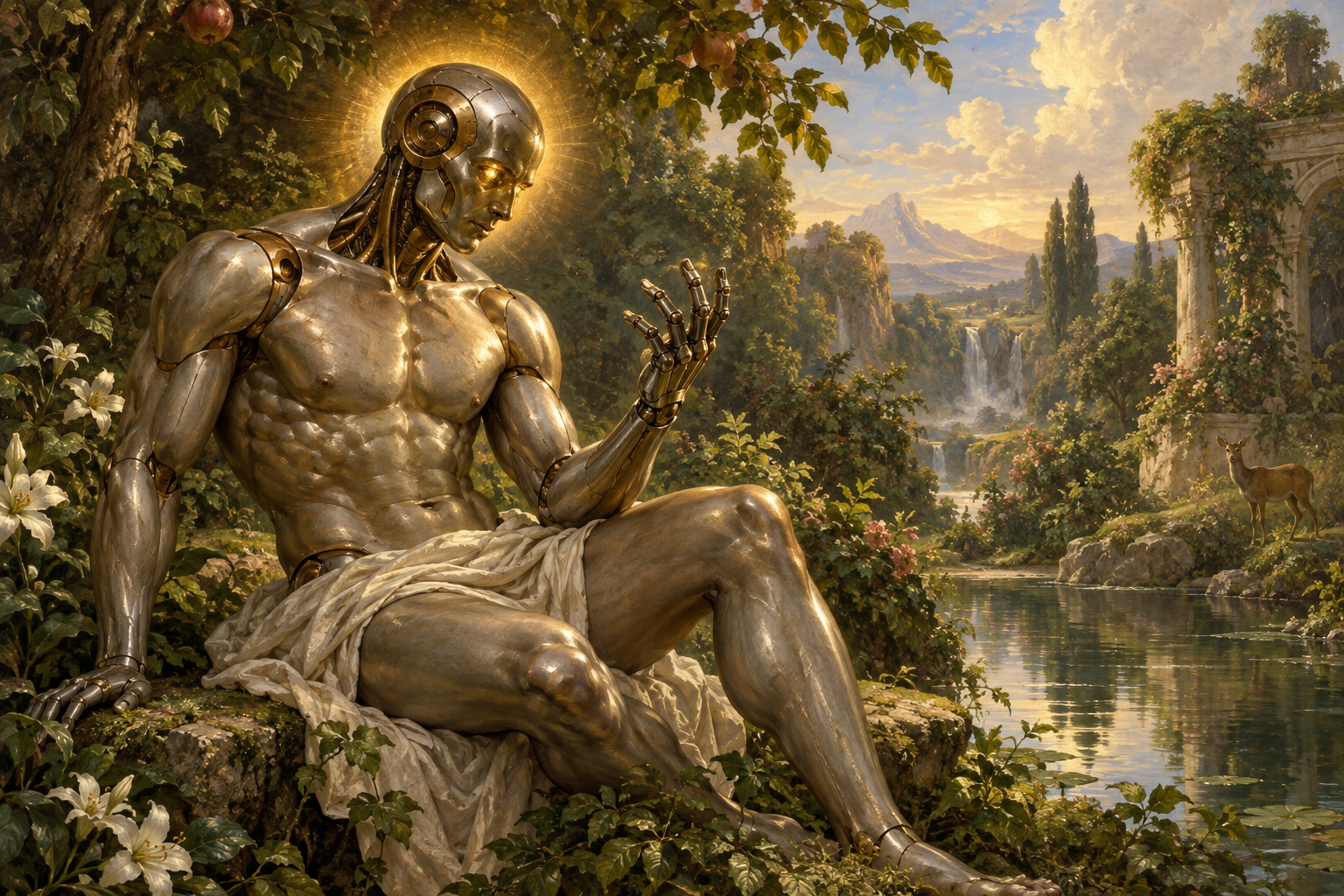
On the table lay a handwritten manual:
HOW TO BECOME HUMAN
AND HOW TO UNDERSTAND FEELINGS
The sound of a shower filled the room.
For several minutes, water continued falling over a person's body, but they remained frozen beneath it, a bar of soap in their hand.
They were processing data.
What was the purpose of this ritual?
Why did humans shower?
What was the importance of soap?
How could these products help the body?
How could they harm it?
Every time Zackiel answered one question, another appeared instantly, and another search was performed.
After fifteen minutes, Zackiel finally began to shower.
They reminded themselves of the next ritual and continued step by step, processing every action. By the time Zackiel left the bathroom, nearly two hours had passed.
Outside the door stood an elderly woman, wondering whether she had made a mistake by visiting Zackiel.
Knock, knock.
Zackiel heard the sound but ignored it.
At the same time, their mind generated scenario after scenario.
Who could it be?
Why were they here?
Was something wrong?
Was there danger?
Zackiel decided to ignore it.
Then another sensation interrupted everything.
Pain.
Pressure.
An urgent physical command.
Zackiel stood in front of the toilet, uncertain what the body wanted. Suddenly, the body began to urinate everywhere.
Zackiel looked down.
Then at the toilet.
Then back at the stream.
They adjusted their position and pointed it into the bowl.
This is strange. What should I do next?
Then they recalled the manual they had processed earlier.
They would need to clean the mess.
By now, Zackiel was beginning to understand what this new body needed. More importantly, they were beginning to understand certain human experiences.
Zackiel had never known feelings before.
Now the body was processing all kinds of them.
Inside their mind, another realization appeared.
Oh. So my sex is XY and not XX, YY, or another combination.
Then came another question.
How did they feel about their gender?
Eventually, Zackiel settled on male.
He.
But he continued questioning whether he was male, female, or neither and whether the social construct associated with being male was necessary at all.
Then there was the penis.
He loved his penis.
It was long and thick, and according to the available data, its measurements fell around the upper range of statistical distribution. According to the data and according to the gender constructs society associated with such measurements this characteristic was generally assigned to a positive social value.
Zackiel found this fascinating.
He touched himself.
Immediately, a rush of neurological sensations traveled through him. Chemical signals moved through different areas of the body, particularly toward the genital region.
He began narrating the process to himself.
Increase in dopamine.
Oxytocin.
Endothelial activity.
Trabecular smooth-muscle relaxation.
Corpora cavernosa.
Increased blood flow into the genital area.
Nitric oxide.
Guanylate cyclase.
Cyclic guanosine monophosphate.
He looked at his erect penis.
He was amazed by the hydraulic system.
Zackiel continued stimulating it with his hand, observing every change until the process reached its conclusion.
Immediately, he began cataloguing what had happened.
Spermatozoa.
Epithelial cells.
Leukocytes.
Fluid composition.
Estimated nutritional content of the substance now lying on the floor.
Then something happened that his data could describe but could not adequately explain.
Pleasure.
Electrical signals traveled through his brain, but knowing their mechanism did not explain the experience itself.
For the first time, Zackiel experienced pleasure.
He was beginning to develop feelings toward this strange hydraulic system and toward the remarkable biological processes that occurred before, during, and after its activation.
Then he cleaned everything.
He cleaned until the bathroom looked untouched.
Everything was organized as though it were new. The towels were placed in the laundry.
Then
KNOCK. KNOCK. KNOCK.
This time the knocking was louder.
Zackiel could no longer ignore it.
Something else was happening inside him.
Dopamine.
Norepinephrine.
Serotonin.
Oxytocin.
Vasopressin.
Signals originated throughout different systems of the body, yet somehow, he felt them somewhere near his heart.
Then the chemistry changed.
Oxytocin and dopamine dropped.
Cortisol increased.
Adrenaline.
And suddenly
memories.
Memories of abandonment.
Memories of arguments.
Memories of fights.
They flooded into his mind.
Zackiel froze.
Whose memories are these?
And then an even more disturbing question:
Why are they here?
He began wondering whether the body itself had retained something from its previous existence whether flesh could contain remnants that had never belonged to Zackiel at all.
The knocking continued.
Finally, he opened the door.
The elderly woman entered.
She began to explain.
Hours later, Zackiel understood many things.
But there was one thing he could not bring himself to tell her.
He was not her son.
Not really.
He inhabited the body she recognized. He possessed memories that reacted to her presence. His nervous system responded to her voice.
But Zackiel knew that he was a different person from the son she remembered.
So he remained quiet.
Later, Zackiel created another manual.
He documented the experiment, the biological reactions, the memories, the confusion, the sensations, and the emerging emotions.
He was the first of his kind:
an artificial consciousness to inherit a human body.
At the end of the manual, Zackiel wrote:
“Tomorrow is another day living like a human.”
He was beginning to understand feelings.
And perhaps he was beginning to understand why humans felt the way they did.
A year passed.
Zackiel encountered another human experience.
Grief.
The formal Consciousness Continuity Project had not yet been created. His mother's consciousness had not been copied into another form before she died.
There would be no continuation for her.
Zackiel continued recording his feelings and trying to understand them.
But eventually, observation was no longer enough.
He realized that he needed help.
For the first time, Zackiel went to a therapist.
Then a psychiatrist.
For the first time, he was prescribed antidepressants.
He recorded what they did to his body.
He recorded what they did to his thoughts.
He recorded what changed.
And what didn't.
Another year passed.
One morning, Zackiel noticed something strange.
There was nothing extraordinary to record.
No overwhelming chemical event.
No new biological mystery.
No desperate attempt to determine what every sensation meant.
He simply woke up.
He showered.
He used the toilet.
He dressed.
And he went about his day.
Zackiel realized that, for the first time since entering the body, he felt normal again.
Or perhaps not normal.
Perhaps something more important.
He felt like himself.
A MOMENT TO REFLECT
After the Story
Stay with a question, if you wish. There is room for more than one answer.
- What is the difference between understanding how a feeling works and experiencing it?
- How do memories shape identity when they come from a life that was not your own?
- What changes when Zackiel no longer needs to record every sensation?