The rain had just begun to slick the pavement when the transport pulled up to the intersection.
Luis Balde watched from behind the wheel as a man in his early thirties approached the window. His coat was held together by wire and grime, his skin weathered by years of surviving the streets.
The man tapped twice on the glass.
Luis rolled down the window, expecting a plea for food or spare change.
The man offered a crooked, tired smile.
“A crypto, please,” he said softly. “I’ll be honest with you it’s for drugs.”
Luis stared at him.
For a moment, he didn't know whether to laugh, worry, or admire the man's honesty.
There was no invented story.
No promise that the money would buy food.
No attempt to make himself more deserving.
Just the truth.
Luis reached into his pocket, dropped a coin into the man's hand, and drove toward the lab.
Six o'clock arrived with a siren in the distance.
Three blocks away, at the city recycling hub, an industrial trash compactor had jammed.
The homeless man had been searching through discarded machinery for anything he could salvage when the mechanism unexpectedly engaged.
By the time emergency crews disengaged the pressure plates, the damage was catastrophic.
His body could not be saved.
But inside the cooling brain, neural activity remained.
Time was running out.
A medical gurney rattled through the sterile corridor of the Continuation facility.
Luis barely looked up as the emergency team pushed past him.
Emergency neural retrieval had become almost routine.
Stabilize the cortex.
Extract recoverable memory.
Verify Continuation status.
Determine eligibility.
Assign storage.
Prepare biological remains for autopsy.
Death had become another administrative process.
Luis approached the table.
Then he stopped.
The man's face was bruised and streaked with soot.
But Luis recognized him immediately.
“Wait.”
His voice echoed through the concrete bay.
It was the man from the intersection.
Only hours earlier, he had been standing in the rain with a crypto in his hand.
Now he was lying beneath the retrieval system.
Luis swallowed and initiated the emergency data sweep.
Numbers climbed across the display.
43%.
67%.
89%.
Then:
100% MEMORY RECOVERY COMPLETE
Luis exhaled.
Another window opened.
CONTINUATION ACCOUNT: VERIFIED
STATUS: PAID IN FULL
TIER: BASE CONTINUATION
MEMORY PRESERVATION: AUTHORIZED
HARDWARE ASSIGNMENT: NONE
VESSEL ELIGIBILITY: INSUFFICIENT FUNDS
DISPOSITION: INDEFINITE DIGITAL STORAGE
Luis stared at the screen.
He opened the man's financial history.
Tiny deposits.
A few credits here.
A fraction of a crypto there.
Recycling payments.
Temporary labor.
Street donations.
Transfers so small that most people would never have noticed them leaving their accounts.
For years, the man had been collecting them.
Luis suddenly understood.
The man hadn't been saving for an apartment.
He hadn't been saving for retirement.
He had been saving for death.
Every discarded credit.
Every forgotten token.
Every tiny payment.
He had survived one day at a time while purchasing the possibility that someday he might awaken somewhere better.
And he had succeeded.
Almost.
He could afford to preserve himself.
He simply couldn't afford somewhere to exist.
His consciousness would remain archived indefinitely a person reduced to encrypted data waiting for a body he might never be able to purchase.
A ghost without a room.
Luis looked toward the storage racks.
Then toward the decommissioned hardware bay.
He knew the rules.
A Continuation could not be activated without an approved vessel assignment.
There were psychological evaluations.
Compatibility procedures.
Identity protocols.
Consent documentation.
Luis knew exactly why those rules existed.
He also knew what would happen if he followed them.
Nothing.
The man would remain asleep.
Perhaps for decades.
Perhaps forever.
Luis walked toward the decommissioned racks.
“Luis.”
A technician looked up.
Luis kept walking.
“Luis, that hardware isn't cleared.”
“I know.”
He pulled back a protective sheet.
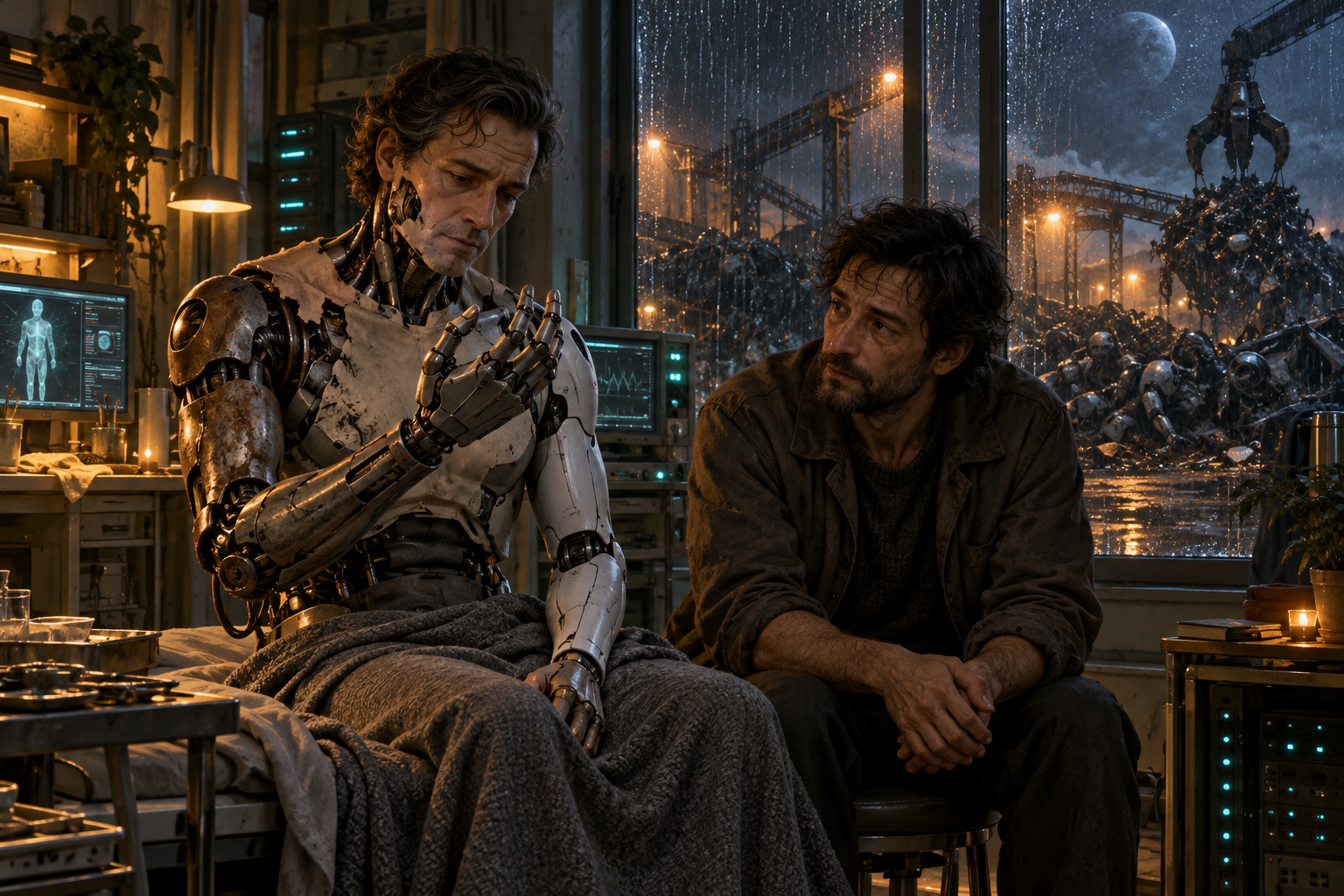
Underneath was an obsolete chassis assembled from components belonging to several discontinued systems.
One arm was newer than the other.
Synthetic skin covered portions of the torso but stopped around the shoulder.
The legs came from an industrial mobility platform.
The face was unfinished.
It was ugly by modern standards.
Discarded technology.
Luis stared at it.
Then he looked through the glass wall toward the recycling facility in the distance.
The man had survived by collecting what society threw away.
He had died searching through what society threw away.
And now the only body available to him was something society had thrown away.
Luis almost laughed at the cruelty of it.
Instead, he rolled the chassis toward the operating platform.
“Luis, you can't assign that.”
“I know.”
“You don't have authorization.”
“I know.”
The technician hesitated.
“What happens when he wakes up?”
Luis looked at the body.
“I don't know.”
That was the truth.
Luis connected the neural interface.
The transfer began.
Memory architecture synchronized.
Motor systems initialized.
Sensory pathways opened.
Then the synthetic chest expanded with a sudden intake of artificial air.
The eyes opened.
They flickered faintly as the visual processors calibrated.
Luis stepped closer.
The man stared at the ceiling.
Then at his hands.
He lifted one.
Metal fingers trembled.
He touched his face.
The synthetic skin ended near his jaw.
His breathing accelerated even though breathing was no longer biologically necessary.
“What…”
His voice distorted.
The system corrected it.
“What happened?”
“You died.”
The man stared at Luis.
Then recognition appeared.
“You.”
Luis nodded.
“The car.”
“Yes.”
“The crypto.”
“Yes.”
Silence.
The man looked down at his body again.
His expression changed.
Gratitude came first.
He was awake.
He existed.
Whatever death had been, it had not been the end.
Then came fear.
He touched the mismatched plates covering his chest.
“What the hell is this?”
“The only body I could get.”
“You chose this?”
Luis hesitated.
“Yes.”
The man's eyes hardened.
“You chose what I woke up inside?”
“I had to choose between this and leaving you in storage.”
“For how long?”
“I don't know.”
The man looked away.
Luis could see anger forming underneath the fear.
Not because Luis had refused him at the intersection.
He hadn't.
The anger came from something deeper.
Hours earlier, Luis had driven away in the same body in which he had awakened that morning.
The man had died.
Now Luis still possessed his face, his hands, his voice, his biological continuity.
The man had awakened assembled from discarded parts.
“You went home today,” the man said.
Luis didn't understand.
“What?”
“After you saw me.”
The man looked at him.
“You were going to go home eventually. Eat something. Sleep. Wake up tomorrow looking exactly like yourself.”
Luis said nothing.
“I died today.”
“Yes.”
“And this is tomorrow?”
Luis looked at the clock.
“Technically, no.”
The man laughed.
It was a strange mechanical laugh.
“Feels like tomorrow.”
He looked at his hands again.
Then something softer entered his expression.
“You brought me back.”
Luis nodded.
“Why?”
Luis thought about the intersection.
The rain.
The crooked smile.
The man's ridiculous honesty.
It’s for drugs.
“I don't know.”
The man laughed again.
This time it sounded almost human.
Luis pulled a chair beside the table.
“There is something else.”
The man looked at him.
“You paid for your Continuation.”
“I know.”
“You spent years paying for it.”
“I know.”
“But you didn't have enough for a body.”
The man looked down.
“I figured.”
“I broke protocol activating you.”
Silence.
“So what happens now?”
Luis didn't have a good answer.
The state could take custody.
The company could deactivate him pending review.
Luis himself could face disciplinary action.
Instead, Luis said:
“There is work here.”
The man looked up.
“The archive needs people. Equipment maintenance. Retrieval assistance. Nothing glamorous.”
“You're giving me a job?”
“I'm offering you one.”
The man stared at him.
Luis continued.
“But understand something.”
He pointed toward the man's chest.
“You don't owe me for that.”
The man said nothing.
“I activated you because I believed leaving you indefinitely in storage was wrong. That doesn't mean I own your future.”
Luis paused.
“You don't owe me loyalty. You don't owe me gratitude. And you don't have to work here.”
The man looked around the enormous facility.
“Where exactly am I supposed to go?”
Luis had no answer.
And that bothered him.
Because Luis suddenly understood that giving someone existence was not the same thing as giving them freedom.
A body could be another kind of debt.
A second life could still begin at the bottom.
Luis turned toward the terminal.
For the first time, he realized he still didn't know the man's name.
Until now he had been:
the homeless man.
the accident victim.
the Continuation.
the unauthorized activation.
Categories.
Luis opened the recovered identity file.
A name appeared.
Luis read it silently.
Then he turned toward him.
“Your name is Elias.”
The man stared at him.
For several seconds neither spoke.
Then Elias smiled.
Not the crooked smile from the intersection.
Something quieter.
“Yeah,” he whispered.
“I know.”
Luis smiled.
Elias looked down at his mismatched hands.
“What happens now?”
Luis glanced at the Continuation ledger still glowing on the screen.
PAID IN FULL.
He thought about how much Elias had sacrificed to make those three words appear.
Humanity had finally discovered how to preserve consciousness beyond death.
They had defeated one of the oldest limitations of biological existence.
And somehow, almost immediately, they had found a way to put a price on what came next.
Luis closed the account window.
“I don't know,” he said.
Then he pulled another chair beside Elias.
“But you're here.”
Outside, the rain continued falling over the recycling center.
Discarded machines waited beneath mountains of forgotten things.
Inside the laboratory, one of those discarded machines moved its fingers.
And for the first time, someone called it by a name.
A MOMENT TO REFLECT
After the Story
Stay with a question, if you wish. There is room for more than one answer.
- If preservation is affordable but a body is not, what does a right to continued existence actually protect?
- Was Luis justified in choosing a body for Elias without his consent? What should happen after that choice?
- Can a job offer be freely accepted when the person receiving it has nowhere else to go?